
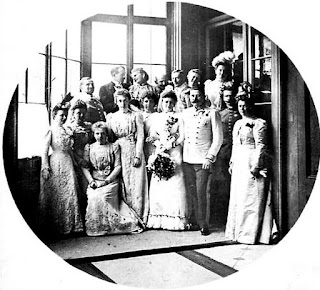
Sophie Chotek von Chotkova was the daughter of the chief equerry at the Imperial Court in Vienna. When a young woman, Sophie became lady in waiting to the Archduchess Isabella of Pressburg. Archduke Franz Ferdinand, heir to the Austro-Hungarian throne, first met Sophie at a dance in Prague in 1888. The couple fell in love but although Sophie came from a prominent Bohemian family, Franz Ferdinand knew that she would not be accepted as the wife of the future emperor.
Sophie and Franz Ferdinand kept their relationship a secret for over two years. When Franz Ferdinand began to make regular visits to the home of Archduke Friedrich of Pressburg, it was assumed he had fallen in love with his eldest daughter, Marie Christine.
One evening, after Franz Ferdinand had been staying at the home of Archduke Friedrich, a servant found a watch and locket he had left behind. When the Archduchess opened the locket, she found it contained a photograph. She expected it to be a picture of her daughter, Marie Christine, and was shocked and angry to discover it was of Sophie, her lady in waiting. Sophie was immediately dismissed and the knowledge of her relationship with Franz Ferdinand created a public scandal.
Franz Ferdinand, beloved husband of Sophie Chotek
Emperor Franz Josef immediately made it clear to Archduke Franz that he would not be allowed to marry Sophie. To be an eligible partner for a member of the Austro-Hungarian royal family, you had to be descended from the House of Hapsburg or from one of the ruling dynasties of Europe.
Franz Ferdinand insisted he would not marry anyone else. Emperor Wilhelm II of Germany, Tsar Nicholas II of Russia and Pope Leo XIII all made representations to Franz Josef on Franz Ferdinand's behalf arguing that the the disagreement was undermining the stability of the monarchy.
In 1899 Emperor Franz Josef agreed a deal with Franz Ferdinand. He was allowed to marry Sophie but it was stipulated that her descendants would not be allowed to succeed to the throne. It was also pointed out that Sophie would not be allowed to accompany her husband in the royal carriage nor could she sit by his side in the royal box.
Franz Josef did not attend the wedding. Nor did his brothers or their families. The only people of the royal family who went to the ceremony was Franz Ferdinand's stepmother, Maria Theresia, and her two daughters. Over the next few years the couple had three children: Sophie (1901), Maximilian (1902) and Ernst (1904).
In June of 1914, Sophie traveled with her husband to Sarajevo. While driving to City Hall, a would-be assassin threw a bomb at her husband which missed, exploding nearby. After the assassination attempt, Franz Ferdinand wanted to send Sophie out of town for her safety. She insisted on staying beside him for the remainder of the tour. While driving from City Hall to the hospital, to visit those injured in the bombing, another assassin (Gavrilo Princip) shot Franz Ferdinand in the neck and Sophie in the abdomen. Franz died within minutes, his last words were to his1917 stamp honoring Franz and Sophie. "dearest Sophie", imploring her to live for the sake of their children. Sophie died less than an hour later from internal bleeding. The assassinations, along with the arms race, nationalism, imperialism, militarism, and the alliance system all contributed to the beginning of World War I, which began less than two months after Franz Ferdinand's death, with Austria-Hungary's declaration of war against Serbia.
Sophie apparently bore the insults she had to endure with dignity and more good humor than Franz Ferdinand. One of the reasons the couple made their ill-fated trip to Sarajevo was that, as their activities in Bosnia-Herzegovina would not be subject to the same rigid rules as in Vienna, Franz Ferdinand could insist that Sophie be treated with the deference he felt she was due. (“If Franz Ferdinand Had Not Loved His Wife” is the title of a well-known article on an alternative history of World War I.) After the assassination, even in death, protocol had to be observed: since Franz Ferdinand knew that the Court would never allow Sophie to be buried in the Imperial Vault at the Kaisergruft in Vienna, he made arrangements for tombs at Schloss Artstetten, one of his castles.


